 Jam Jam
Guide
Guides & tips
Short, no-nonsense guides to play, tune and find chords faster: each one backed by a Jam Jam tool you can open right away.
Convert almost any music file into a songbook, and build on our new API
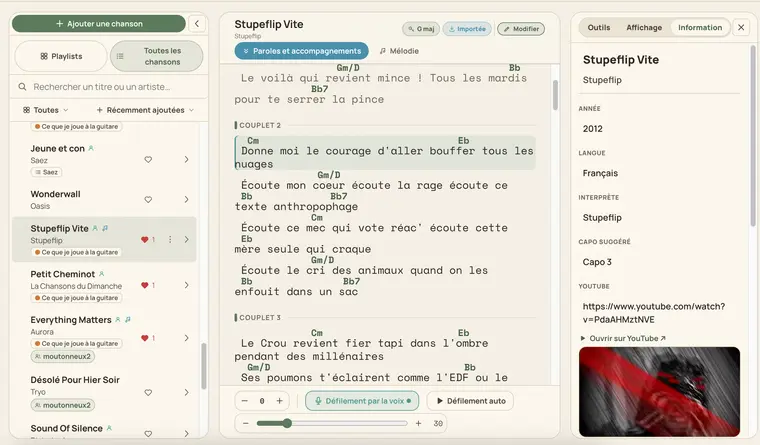
Jam Jam already turned audio into chords and lyrics. The same server pipeline now reads PDFs, photos, scanned sheet music, MIDI, ChordPro, plain text and pasted web pages too, and can produce whichever output you actually need in return. It runs on jam-jam.org/app/convert, in the mobile app, and now behind a public API.
Read more →Detecting AI-generated music: method and limits
AI-generated music is increasingly common. Jam Jam helps you look for signs of generation: paste a link or upload a file for an indicative result.
Guide · Your online chord songbookEverything the Jam Jam API converts, from a recording to sheet music
The conversion engine behind jam-jam.org/app/convert and the mobile app is also a public REST API: send it a file, a link or plain text, and get back chords, lyrics, key, tempo, or a portable export. Here is exactly what it accepts, what it returns, and how to call it.
Guide · Free online tuner
How to tune your guitar
A guitar that stays out of tune ruins even the best playing. Here is the simplest way to tune it, in a couple of minutes: with the standard notes, alternate tunings and a free online tuner.
Guide · Chord and key detector, free and unlimited in your browser
How to find the chords of a song
To find the chords of a song, drop the audio file into a chord detector: Jam Jam returns the chords, the key and the tempo, for free and with no limit in your browser. Here is that method and three others, with their limits.
Guide · Online piano keyboard
Learn piano chords
A piano chord is built by stacking notes on a root: major = root, major third (+4 semitones) and fifth (+7), so C E G for C. Minor = minor third (+3): C E♭ G. A seventh adds +10 (C7) or +11 (Cmaj7). Jam Jam generates 18 chord formulas on all 12 roots.
Guide · Online piano keyboard
The Keyboard gets a makeover: 142 sounds, ranges and a capo
The Jam Jam keyboard just received its biggest update: a unified catalogue of 142 instrument sounds sorted into 17 families, favourites that follow you from phone to browser, keys that adapt to each instrument’s real range, and a brand-new keyboard capo. A tour of what changed, on mobile and on the web.
Guide · Online piano keyboard
A MIDI keyboard and drum-pad app, in your pocket
Plug a USB MIDI keyboard into Jam Jam and your phone becomes a real pocket workstation: eight playable drum pads with techno and hardtek kits, eight assignable synth knobs with MIDI-learn, an arpeggiator, your own SoundFonts and near-instant latency. A tour of everything the keyboard can now do, on Android.
Guide · Your online chord songbook
Make a karaoke video from any song, word by word
Our server lines up your lyrics to your own recording, word by word, then Jam Jam turns it into a full karaoke video: six moods, full screen, and the chord diagrams scrolling underneath. Here is exactly how it works, and what it does and does not do to your audio.
Guide · MP3 to chords: find the chords of an MP3, free and unlimited in your browser
Get the lyrics out of an MP3, with AI
Drop an audio file into Jam Jam and an AI model listens through the whole track and writes out the lyrics, line by line, timed to the music, alongside the chords, the key and the tempo. Here is what actually happens to your file, and where the AI runs.
Guide · Read a tab that actually playsTurn a recording into a tab, with AI
Record yourself playing or singing a single line, drop it into Jam Jam, and an on-device AI follows the pitch note by note and turns it into a real melody you can read as a tab, a staff, falling notes and more. It is built for one melodic line at a time, not a full mixed song: here is exactly what that means.
Guide · Online piano keyboardHow to play the virtual piano online, four different ways
Jam Jam turns your screen into a playable virtual piano in your browser, no download and no account. Here is exactly how to play it: with the mouse, on a touchscreen, on your computer keyboard, or with a real MIDI keyboard plugged in, plus the chord mode and scale highlighting that make it easy even without reading music.
Guide · Free online oud tuner
How to tune an oud
An oud has eleven or twelve strings in courses and no frets, so a tuning mistake is not hidden by a fret. Here is the simplest way to tune it clean, with either of the two common tunings.
Guide · Free online harp tuner
How to tune a lever harp
To tune a lever harp, put all levers down, pick the preset that matches how it is set up (C major, E flat major or G major) and tune the 34 strings one by one, from the bass up, from C2 (65.41 Hz) to A6 (1760 Hz) in C major. Then do a second pass.
Guide · Free online charango tuner
How to tune a charango
The charango's five courses do not go from low to high: the middle course is the highest. Once you know that, tuning it is quick. Here is the routine.
Guide · Free online tuner
Learn guitar chords by playing
Repeating a chord alone in front of a diagram gets old fast. Playing it at the right moment to move a game forward gives you a reason to try again. Here is how to learn chords by playing, on your real guitar.
Guide · Free online tuner
Note frequencies: the complete chart in Hz
In equal temperament with A4 = 440 Hz, each semitone multiplies the frequency by 2^(1/12), about 1.0595. Middle C (C4) is 261.63 Hz, the lowest piano key A0 is 27.50 Hz and the highest, C8, is 4,186.01 Hz. The chart below lists all 108 notes from octave 0 to octave 8.
Guide · Transpose a song and find your capoCapo chart: which chord sounds with a capo
With a capo on fret N, every chord shape sounds N semitones higher. A G shape played at capo 2 gives an A, a C shape at capo 3 gives an E♭. The chart below gives the real chord for the eight most common open shapes, from fret 1 to fret 7, and the capo position for every major key.
Guide · Scales on the online keyboard
Circle of fifths: keys, key signatures and how to use it
The circle of fifths arranges the 12 major keys a fifth apart: C, G, D, A, E, B, F♯, then D♭, A♭, E♭, B♭, F. Each step clockwise adds one sharp to the key signature, each step counterclockwise adds one flat. Every key’s relative minor shares the same key signature.
Guide · Read a tab that actually playsHow to read guitar tabs
Guitar tab draws the six strings as six lines, with the high E string at the top. Each number on a line tells you which fret to press on that string, and 0 means the open string. You read from left to right, and numbers stacked vertically are played together, as a chord.
Guide · Free online metronomeHow to find the tempo (BPM) of a song
BPM is the number of beats per minute. To find it, tap along on a tap tempo button for a few bars, or count the beats for 15 seconds and multiply by 4. Automatic detection can also estimate it from the audio file. Most songs sit between 60 and 180 BPM.
Guide · Chord diagrams for 26 instruments
The most common chord progressions
A chord progression is written in scale degrees (Roman numerals) so it works in every key. The most common are I-V-vi-IV (in C: C G Am F), I-vi-IV-V, vi-IV-I-V, I-IV-V, ii-V-I in jazz, the 12-bar blues and, in minor, i-VII-VI-VII. The charts give their chords in several keys.
Guide · Chord and key detector, free and unlimited in your browser
How to master a song for free: a clear guide
Your mix is finished and you want it to hold up on Spotify, YouTube or Apple Music. This guide explains what mastering really does, gives each platform’s loudness target and where it comes from, walks through a free method step by step and lists the mistakes that ruin a master.
Guide · Chord and key detector, free and unlimited in your browserMaster audio through an API: curl, Python, Node, batch and MCP
Jam Jam’s API masters an audio file on the server with the same settings as the free browser tool. You upload a file, pick a preset or send your own settings, follow the job and download a WAV. This guide gives the whole path in curl, Python and Node, batch processing, error handling and the MCP server for assistants.