 Jam Jam
The formula for the frequency of a note
A note’s frequency follows from its MIDI number n (C4 = 60, A4 = 69): f = 440 × 2^((n − 69) / 12). Going up an octave doubles the frequency (A4 = 440 Hz, A5 = 880 Hz), going down an octave halves it (A3 = 220 Hz). The twelve semitones of an octave all share the same ratio: that is equal temperament, the reference tuning of pianos, guitars and electronic tuners.
f = 440 × 2(n − 69) / 12
n = the note’s MIDI number (C4 = 60, A4 = 69). Each semitone multiplies the frequency by about 1.0595.
Note frequency chart, octaves 0 to 8 (A4 = 440 Hz)
The chart gives each note’s frequency in hertz, rounded to two decimals, in scientific pitch notation: octave 4 starts at middle C, and the reference A4 is highlighted. Black keys carry both names (C♯ and D♭ are the same key in equal temperament). An 88-key piano runs from A0 (27.50 Hz) to C8 (4,186.01 Hz).
| Note | Solfège | Octave 0 | Octave 1 | Octave 2 | Octave 3 | Octave 4 | Octave 5 | Octave 6 | Octave 7 | Octave 8 |
|---|---|---|---|---|---|---|---|---|---|---|
| C | Do | 16.35 | 32.70 | 65.41 | 130.81 | 261.63 | 523.25 | 1,046.50 | 2,093.00 | 4,186.01 |
| C♯/D♭ | Do♯/Ré♭ | 17.32 | 34.65 | 69.30 | 138.59 | 277.18 | 554.37 | 1,108.73 | 2,217.46 | 4,434.92 |
| D | Ré | 18.35 | 36.71 | 73.42 | 146.83 | 293.66 | 587.33 | 1,174.66 | 2,349.32 | 4,698.64 |
| D♯/E♭ | Ré♯/Mi♭ | 19.45 | 38.89 | 77.78 | 155.56 | 311.13 | 622.25 | 1,244.51 | 2,489.02 | 4,978.03 |
| E | Mi | 20.60 | 41.20 | 82.41 | 164.81 | 329.63 | 659.26 | 1,318.51 | 2,637.02 | 5,274.04 |
| F | Fa | 21.83 | 43.65 | 87.31 | 174.61 | 349.23 | 698.46 | 1,396.91 | 2,793.83 | 5,587.65 |
| F♯/G♭ | Fa♯/Sol♭ | 23.12 | 46.25 | 92.50 | 185.00 | 369.99 | 739.99 | 1,479.98 | 2,959.96 | 5,919.91 |
| G | Sol | 24.50 | 49.00 | 98.00 | 196.00 | 392.00 | 783.99 | 1,567.98 | 3,135.96 | 6,271.93 |
| G♯/A♭ | Sol♯/La♭ | 25.96 | 51.91 | 103.83 | 207.65 | 415.30 | 830.61 | 1,661.22 | 3,322.44 | 6,644.88 |
| A | La | 27.50 | 55.00 | 110.00 | 220.00 | 440.00 | 880.00 | 1,760.00 | 3,520.00 | 7,040.00 |
| A♯/B♭ | La♯/Si♭ | 29.14 | 58.27 | 116.54 | 233.08 | 466.16 | 932.33 | 1,864.66 | 3,729.31 | 7,458.62 |
| B | Si | 30.87 | 61.74 | 123.47 | 246.94 | 493.88 | 987.77 | 1,975.53 | 3,951.07 | 7,902.13 |
Values computed with f = 440 × 2^((n − 69) / 12) and rounded to 0.01 Hz. C4 is middle C.
Calculate a note frequency at another pitch standard (432 or 442 Hz)
Concert pitch is the frequency chosen for A4. 440 Hz is the international standard (ISO 16), but many orchestras tune to 442 Hz and some musicians pick 432 Hz. Changing the reference shifts every note by the same ratio: at 432 Hz, C4 is 256.87 Hz instead of 261.63 Hz. The calculator below applies the formula for the note, octave and reference you choose.
Note names: English letters, Do Re Mi and German notation
The same frequencies carry different names around the world. English uses the letters C D E F G A B, while French, Italian, Spanish and Portuguese use solfège: Do Re Mi Fa Sol La Si. German and Polish (like several Central and Northern European countries) call the note B “H”, and B flat “B”: a German “B” is not an English “B”. Sharps take the suffix “-is” (Fis = F♯) and flats “-es” (Es = E♭).
| English | Solfège | German |
|---|---|---|
| C | Do | C |
| C♯/D♭ | Do♯/Ré♭ | Cis/Des |
| D | Ré | D |
| D♯/E♭ | Ré♯/Mi♭ | Dis/Es |
| E | Mi | E |
| F | Fa | F |
| F♯/G♭ | Fa♯/Sol♭ | Fis/Ges |
| G | Sol | G |
| G♯/A♭ | Sol♯/La♭ | Gis/As |
| A | La | A |
| A♯/B♭ | La♯/Si♭ | Ais/B |
| B | Si | H |
A = 432 Hz or A = 440 Hz: what the facts say
Concert pitch varied widely in history, from roughly 400 to over 450 Hz depending on place and era, before the 440 Hz standard. Today baroque music is often played at 415 Hz, a semitone lower. 432 Hz is simply another reference, about a third of a semitone below 440: no serious study attributes any special effect on body or mind to it. What matters is that every instrument in a group agrees on the same reference. In Jam Jam, on the web and on mobile, the tuner offers 415, 432, 440, 442 and 443 Hz in the settings.
To apply these frequencies to a guitar, read our guide to tuning a guitar.
Frequently asked questions about note frequencies
What frequency is A440?
A440 is A4, the reference note of modern tuning: it vibrates at 440 Hz, 440 cycles per second. It is the A above middle C on the piano, and the international ISO 16 standard since 1975.
What is the frequency of middle C?
Middle C (C4) is 261.63 Hz with A4 at 440 Hz. At 432 Hz it drops to 256.87 Hz; at 442 Hz it rises to 262.82 Hz.
Should I tune to 432 Hz instead of 440 Hz?
It is a matter of choice and of matching the other musicians. 432 Hz is slightly lower (about 32 cents); nothing shows it sounds “better” or heals anything. To play along with recordings or other instruments, 440 Hz remains the reference.
How do I find the frequency of a note that is not in the chart?
Use f = reference × 2^((n − 69) / 12), where n is the note’s MIDI number (C4 = 60, each semitone adds 1). One octave up, multiply by two; one octave down, divide by two.

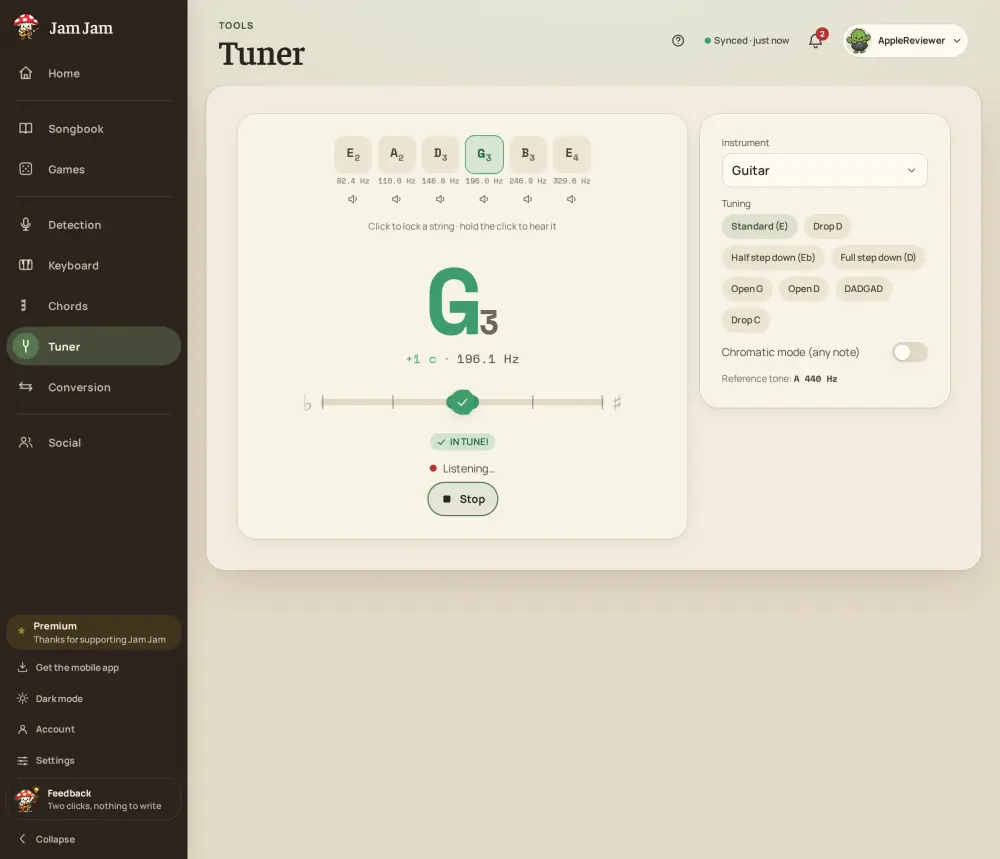
To hear whether your note is in tune, Jam Jam’s free online tuner listens through the mic and shows the offset in cents, at the reference pitch you choose.