 Jam Jam
Free · works in your browser · no sign-up
Free online cavaquinho tuner
A tuner with the Brazilian and Portuguese cavaquinho tunings, right in your browser.
- No account
- No ads
- Nothing to install
In short
To tune a cavaquinho online, allow the microphone, pick Cavaquinho and pluck each string in Brazilian standard tuning: D4 (293.66 Hz), G4 (392 Hz), B4 (493.88 Hz) and D5 (587.33 Hz). Center the needle within ±5 cents. Half step down and the Portuguese tuning are built in too.
- 3 tunings: Brazilian D G B D, half step down, and Portuguese D A B E.
- Standard: an open G major chord, from D4 to D5.
- Portuguese: E4 329.63 Hz, B4 493.88 Hz, A4 440 Hz, D5 587.33 Hz.
- Capo supported in the notebook; in-tune zone of ±5 cents.
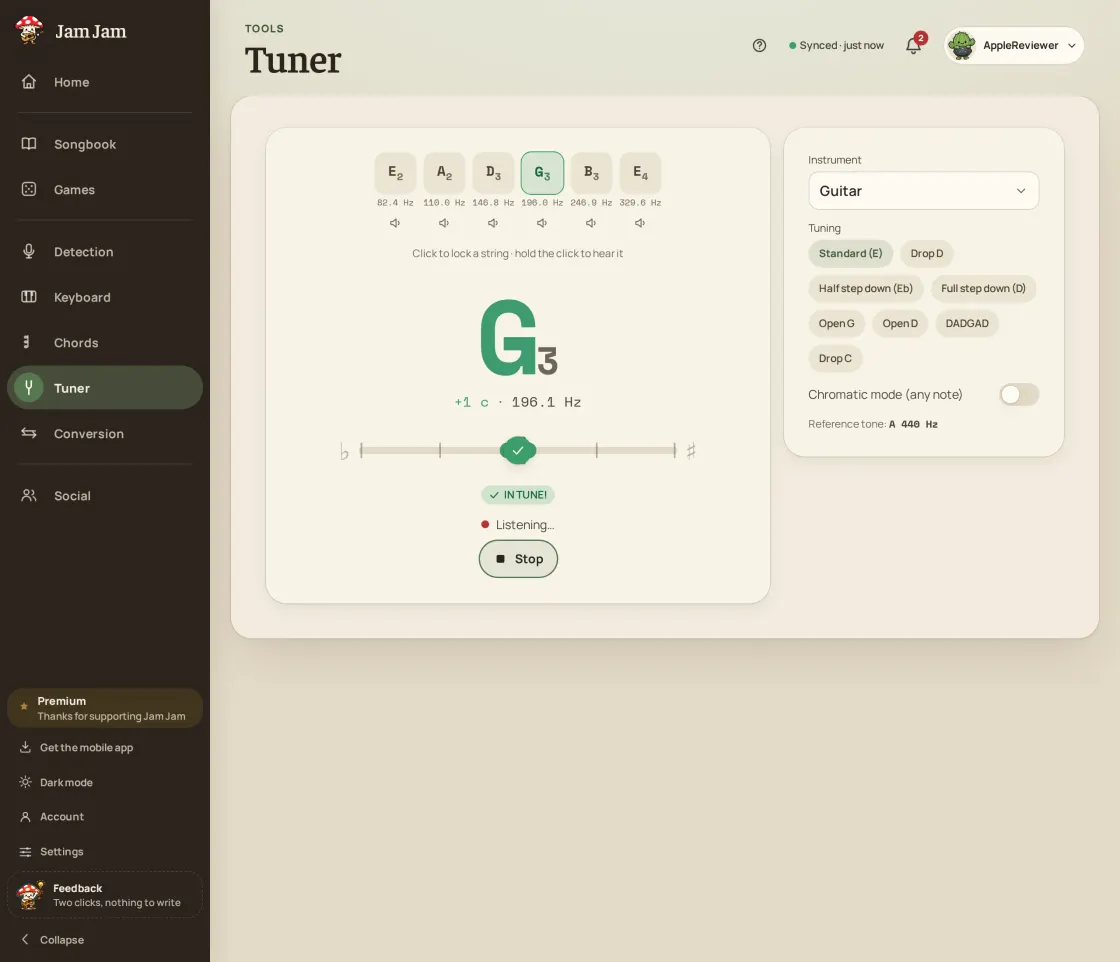
The Jam Jam cavaquinho tuner listens through your microphone and tells you, in real time, which note is sounding and how far sharp or flat you are. Three presets: the Brazilian standard D4, G4, B4, D5, the same a half step down, and the Portuguese high tuning E4, B4, A4, D5. In-tune zone at ±5 cents, cents to the unit, frequency to a tenth of a hertz.
How to tune a cavaquinho
-
Allow the microphone
Open the tuner, pick Cavaquinho and grant mic access: the audio is analysed on your device, nothing is uploaded.
-
Pick your tuning
D-G-B-D for Brazilian samba and choro, half step down if your strings prefer it, the high tuning for Portuguese playing.
-
Tune from the low string up
Pluck the lowest string open, centre the needle, then move up. The tuner locks onto the nearest string.
-
Check the open chord
In D-G-B-D the open strings sound a G major chord: strum them to double-check by ear.
How to tune a cavaquinho
- Tune the lowest string first, D4 in standard tuning.
- Then tune G4, B4 and D5; D5 should sound an exact octave above D4.
- Cavaquinho steel strings are under high tension: turn in small moves so you do not overshoot.
- Strum the four open strings: in standard tuning you should hear a clean G major chord.
Cavaquinho tunings: notes and frequencies
| Tuning | String 1 | String 2 | String 3 | String 4 |
|---|---|---|---|---|
| Standard (D G B D) | D5587.33 Hz | B4493.88 Hz | G4392.00 Hz | D4293.66 Hz |
| Half step down | D♭5554.37 Hz | B♭4466.16 Hz | G♭4369.99 Hz | D♭4277.18 Hz |
| Portuguese (D A B E) | D5587.33 Hz | A4440.00 Hz | B4493.88 Hz | E4329.63 Hz |
A tuner that knows both cavaquinhos
Brazilian D-G-B-D
The standard for samba and choro, declared as the default, plus the same a half step down.
Portuguese high tuning
E4, B4, A4, D5 as its own preset, so a Portuguese cavaquinho is not forced through Brazilian targets.
Reference note in a cavaquinho voice
Every string plays its target note with a real cavaquinho timbre, so you can check a string by ear before touching the peg.
Auto, manual or chromatic
It locks the nearest string by itself; one tap freezes a string, another returns to auto. Chromatic mode covers anything outside the presets.
Why this cavaquinho tuner
- D-G-B-D, half step down, and Portuguese D-A-B-E
- ±5 cents to be in tune, cents to the unit and hertz to a tenth
- 100% free, in your browser, no sign-up and no ads
- Everything is computed on your side: nothing is uploaded

A single-purpose tuner site stops the moment you are in tune. Here the tuner is one tab among others in the Jam Jam notebook: import a song, transpose it, export it to PDF. Offline in the mobile app.
Open the tuner →Related guides
More Jam Jam tools
Cavaquinho tuner FAQ
Is this cavaquinho tuner free?
Completely: no account, no ads, nothing to install. It all runs in your browser, and the microphone audio is analysed on the spot. It is never sent to a server.
Is a cavaquinho tuned like a ukulele?
No: the Brazilian standard is D4, G4, B4, D5, an open G chord, and the strings are steel. A ukulele is G, C, E, A. Jam Jam has separate presets for each instrument.
Why tune a half step down?
To ease string tension or match a singer. The preset keeps the same intervals, one semitone lower: Db4, Gb4, Bb4, Db5.