 Jam Jam
Free · works in your browser · no sign-up
Free online oud tuner
A tuner with the three real oud tunings, Arabic, Turkish and Iraqi, right in your browser.
- No account
- No ads
- Nothing to install
In short
To tune an oud online, allow the microphone, pick Oud and then the tuning. In Arabic standard the six courses are C2 (65.41 Hz), F2, A2, D3, G3 and C4 (261.63 Hz). Tune each string until the needle turns green, within ±5 cents. Turkish and Iraqi tunings are built in too.
- 3 tunings: Arabic standard, Turkish and Iraqi.
- Turkish: D2 73.42 Hz, G2 98 Hz, B2 123.47 Hz, E3 164.81 Hz, A3 220 Hz, D4 293.66 Hz.
- Iraqi: the lowest string drops to F1, 43.65 Hz.
- In-tune zone of ±5 cents, free, no account.
The Jam Jam oud tuner listens through your microphone and tells you, in real time, which note is sounding and how far sharp or flat you are. Three presets: the Arabic standard C2, F2, A2, D3, G3, C4, the Turkish tuning D2, G2, B2, E3, A3, D4, a whole tone higher with a different interval pattern, and the Iraqi tuning F1, A1, D2, G2, C3, F3. In-tune zone at ±5 cents, cents to the unit, frequency to a tenth of a hertz.
How to tune an oud
-
Allow the microphone
Open the tuner, pick Oud and grant mic access: the audio is analysed on your device, nothing is uploaded.
-
Pick Arabic, Turkish or Iraqi
Choose the preset that matches your school and strings; the six targets change with it.
-
Tune from the low course up
Pluck the lowest course open, centre the needle, then move up. The tuner locks onto the nearest course by itself.
-
Match the pair by ear
Tune one string of a course with the needle, then bring its twin onto it until the beating stops.
How to tune an oud
- Pick the tuning of your tradition: Arabic, Turkish or Iraqi. The targets change on every string.
- Courses are doubled: mute one string of the pair and tune the other, then swap.
- Start with the lowest course, then work up to the highest.
- Oud pegs hold by friction: turn while pushing gently towards the pegbox.
- Play each pair together to check the unison, then do a full second pass.
Oud tunings: notes and frequencies
| Tuning | String 1 | String 2 | String 3 | String 4 | String 5 | String 6 |
|---|---|---|---|---|---|---|
| Arabic standard | C4261.63 Hz | G3196.00 Hz | D3146.83 Hz | A2110.00 Hz | F287.31 Hz | C265.41 Hz |
| Turkish | D4293.66 Hz | A3220.00 Hz | E3164.81 Hz | B2123.47 Hz | G298.00 Hz | D273.42 Hz |
| Iraqi | F3174.61 Hz | C3130.81 Hz | G298.00 Hz | D273.42 Hz | A155.00 Hz | F143.65 Hz |
A tuner that knows both oud traditions
Arabic C-F-A-D-G-c
The most common modern tuning, from the low C2 to the high C4, declared as the default preset.
Turkish D-G-B-E-A-d
A separate preset for the Turkish tuning, so you never have to shift Arabic targets by ear.
Reference note in a oud voice
Every string plays its target note with a real oud timbre, so you can check a string by ear before touching the peg.
Auto, manual or chromatic
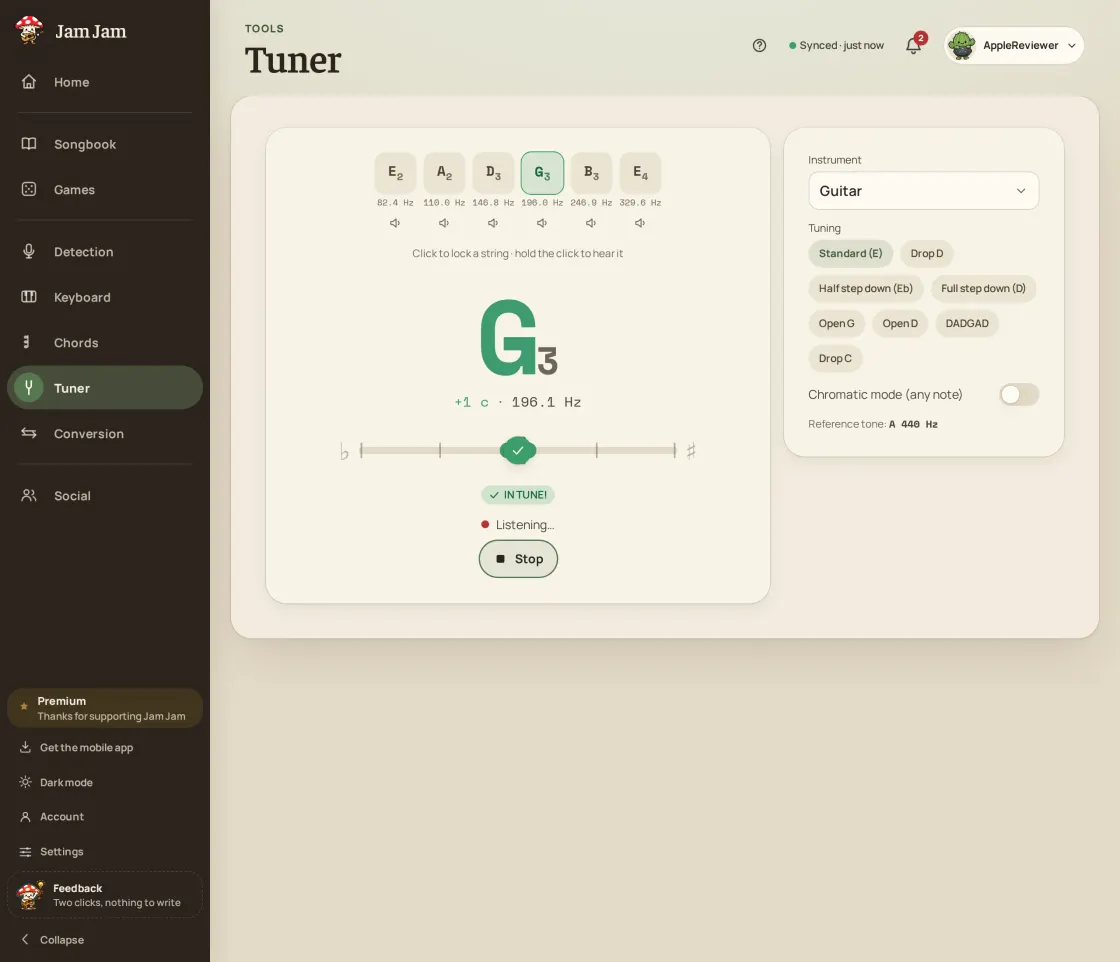
It locks the nearest string by itself; one tap freezes a string, another returns to auto. Chromatic mode covers anything outside the presets.
Why this oud tuner
- Arabic standard, Turkish and Iraqi tunings built in
- ±5 cents to be in tune, cents to the unit and hertz to a tenth
- 100% free, in your browser, no sign-up and no ads
- Everything is computed on your side: nothing is uploaded

A single-purpose tuner site stops the moment you are in tune. Here the tuner is one tab among others in the Jam Jam notebook: import a song, transpose it, export it to PDF. Offline in the mobile app.
Open the tuner →Related guides
More Jam Jam tools
Oud tuner FAQ
Is this oud tuner free?
Completely: no account, no ads, nothing to install. It all runs in your browser, and the microphone audio is analysed on the spot. It is never sent to a server.
Which oud tuning should I use?
If you follow the Arabic tradition, start with C-F-A-D-G-c. Turkish players use D-G-B-E-A-d. Iraqi players have their own tuning. Jam Jam has all three as presets; pick the one your teacher or strings assume.
Does the tuner handle fretless intonation?
It reads whatever pitch you play, open or stopped, so you can check a stopped note against the needle. The presets target the open courses.