 Jam Jam
Free · works in your browser · no sign-up
Free online bass tuner
A bass tuner that hears the low E at 41 Hz: 4 or 5 strings, standard, drop D and half step down, right in your browser.
- No account
- No ads
- Nothing to install
In short
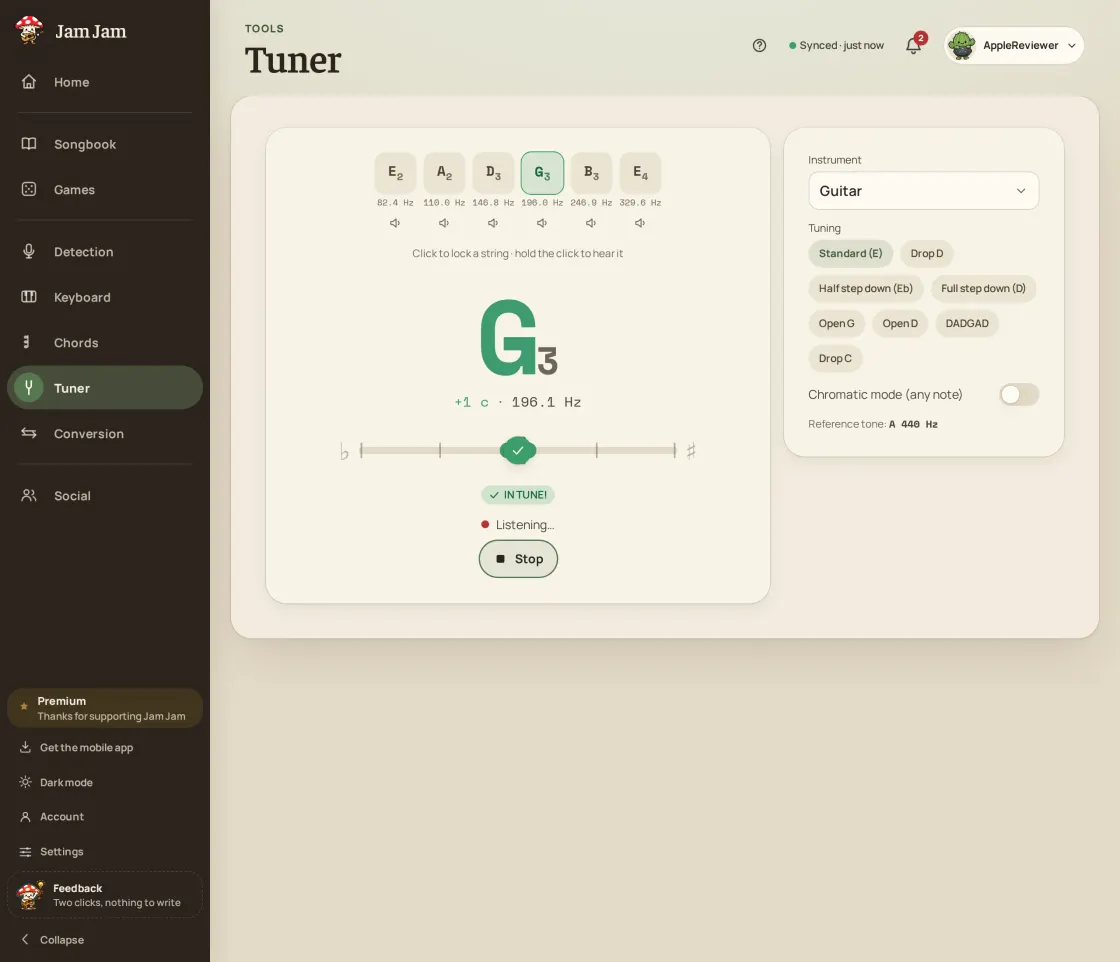
To tune a 4-string bass online, allow the microphone, pick Bass and pluck each open string: E1 (41.20 Hz), A1 (55 Hz), D2 (73.42 Hz) and G2 (98 Hz). Center the needle within ±5 cents. Drop D, half step down and 5-string bass (low B at 30.87 Hz) are built in too.
- 4 tunings: 4-string standard, drop D, half step down, and 5-string B E A D G.
- Lowest string read: B0 at 30.87 Hz on a 5-string, D1 at 36.71 Hz in drop D.
- Detection band cut for bass, reaching down to 30 Hz.
- In-tune zone of ±5 cents, free, in your browser, no account.
The Jam Jam bass tuner listens through your microphone and tells you, string by string, whether you are sharp or flat. Four tunings are ready: three for 4-string bass (standard E A D G, drop D and half step down) and the 5-string standard with its low B. The hard part of a bass is the low end: the low E drops to 41 Hz, the drop D to 37 Hz, the 5-string low B to 31 Hz. Jam Jam computes a detection band specific to the instrument, down to 30 Hz, and reads pitch with YIN over 4096-sample frames: long enough to catch a fundamental that low instead of its harmonic an octave up. No account, nothing to install. And your bass lines wait in the notebook, as tabs read in that same tuning.
How to tune a bass online
-
Allow the microphone
Open the tuner, pick Bass and grant mic access. Jam Jam asks for a raw signal: no noise suppression, no auto gain.
-
Pick your tuning
Standard E A D G, drop D to lower the bottom string, half step down, or 5-string with the low B: the target notes appear at once.
-
Play one open string
Pluck a single string near the bridge and let it ring. The nearest string locks on its own; a tap freezes it.
-
Centre the needle
Turn the tuning key until the needle is centred and green: you are inside ±5 cents of the target note.
How to tune a bass guitar
- Rest the bass on your lap, away from a humming amp, and bring the phone or computer microphone close to the body.
- Start with the lowest string (E1, or B0 on a 5-string): pluck it firmly with your thumb or two fingers and let it ring.
- Wait for the needle to settle before turning: a low string takes a moment to read. Turn the tuning machine a quarter turn at a time.
- If the string is flat, go slightly above the note and come back down: the tension spreads better and the tuning holds longer.
- Do A1, D2 and G2, then go over every string a second time: the neck moves a little when tension changes.
Bass tunings: notes and frequencies
| Tuning | String 1 | String 2 | String 3 | String 4 | String 5 |
|---|---|---|---|---|---|
| 4-string standard (E A D G) | G298.00 Hz | D273.42 Hz | A155.00 Hz | E141.20 Hz | |
| 4-string Drop D | G298.00 Hz | D273.42 Hz | A155.00 Hz | D136.71 Hz | |
| 4-string half step down | G♭292.50 Hz | D♭269.30 Hz | A♭151.91 Hz | E♭138.89 Hz | |
| 5-string standard (low B) | G298.00 Hz | D273.42 Hz | A155.00 Hz | E141.20 Hz | B030.87 Hz |
Built for the low end
It hears 41 Hz, and 37 Hz
The detection band is computed for the instrument and goes down to 30 Hz, so the low E and the drop D read as themselves, not as the octave above.
YIN over 4096-sample frames
A long analysis window is exactly what a 41 Hz fundamental needs; a shorter one grabs a harmonic and announces the wrong string.
Raw microphone, on purpose
Noise suppression and automatic gain are asked to stay off: on bass frequencies they crush precisely what has to be measured.
Reference note in a bass voice
Each string plays its target note with the timbre of a bass, not a piano ping: far easier to match by ear an octave down.
Why this bass tuner
- 4 tunings: standard, drop D, half step down and 5-string (low B)
- Cents to the unit, frequency to 0.1 Hz, green inside ±5 cents
- Automatic string lock, or tap to hold one string
- Free in your browser, no sign-up: offline in the Android app

A bass is where cheap tuners give up: the fundamental is quiet, the harmonics are loud, and the needle ends up an octave too high. Jam Jam cuts its detection band to fit the instrument, down to 30 Hz, and shows cents to the unit next to the frequency to a tenth of a Hz. You can see the gap between 41.2 Hz and 41.9 Hz. And the tuner is only one tab: your bass tablature plays back in the same tuning, bass chord diagrams run to the 20th fret, and the chords of the song land in the same notebook.
Open the bass tuner →Related guides
More Jam Jam tools
Bass tuner FAQ
Is this bass tuner free?
Yes: free, no sign-up, no ads. It all happens in your browser and nothing you play is uploaded: the pitch is computed on your device. The Android app tunes offline as well.
Does it handle drop D and half-step down?
Yes. Three 4-string tunings are built in: standard E A D G, drop D (D A D G) and half step down (Eb Ab Db Gb). The 5-string bass has its own preset too, low B included. For anything else, the chromatic mode names every note from 40 to 1600 Hz.
Why do other tuners show the wrong octave on my low E?
Because a 41 Hz fundamental is weaker than its harmonics, and a short analysis window latches onto one of them. Jam Jam uses YIN over 4096-sample frames and a band reaching 30 Hz, so the low E reads as an E.
Can I tune a 5-string bass?
Yes. The 5-string preset targets B0 (30.87 Hz), E1 (41.20 Hz), A1 (55 Hz), D2 (73.42 Hz) and G2 (98 Hz). A high-C 5-string and the 6-string bass have no preset: for the high string, the chromatic mode names the note.
My phone struggles with the low string: what can I do?
Many phone microphones pick up very low frequencies poorly. Bring the mic closer to the body of the bass and pluck harder. Otherwise, play the 12th-fret harmonic, one octave up, and read it in chromatic mode: the E string should show E2 (82.41 Hz) dead center.
4-string bass: in which order should I tune?
From lowest to highest: E, A, D, G. The E string pulls the neck the most, so tuning it first limits touch-ups. Finish with a second pass over all four strings.