 Jam Jam
Free · works in your browser · no sign-up
Find the key and tempo of a song
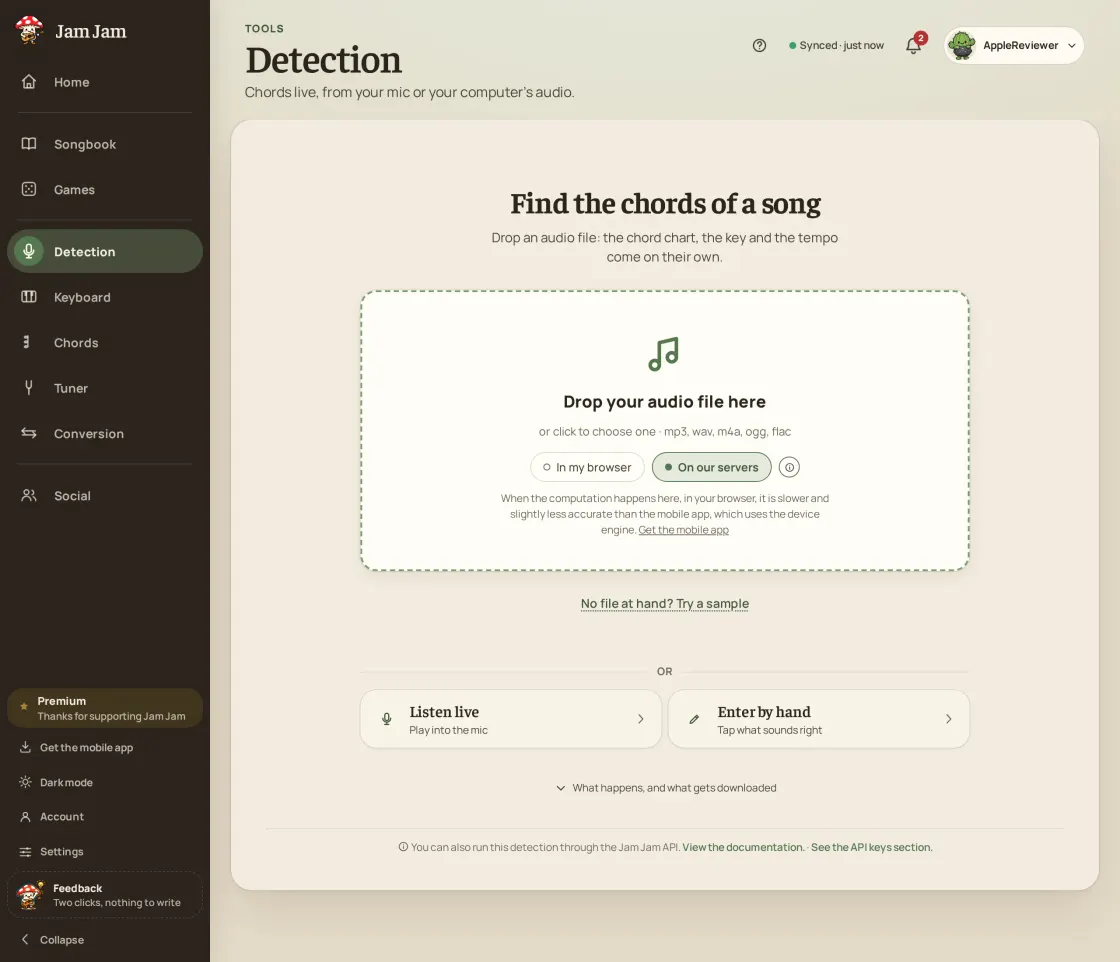
To find the key and tempo of a song, drop the audio file into Jam Jam Detection: it reads them at the same time as the chords. It is free and unlimited in your browser, with no account.
- Free and unlimited in your browser
- No account
- Nothing to install
Key and tempo in short
- An audio file gives the estimated key and the tempo in BPM, together with the time-stamped chords.
- If the tempo found is double or half of the real one, it is fixed in one tap.
- Free and unlimited in your browser, with no account and nothing to install.
- 168 chords recognised: 14 qualities across the 12 keys.
- Your microphone is never sent. A file handled by our server is deleted at the latest within 72 hours.
How to find the key and tempo of an audio file
-
Drop the audio file
Drag an mp3, m4a, wav or flac onto the drop zone, or pick it on your device. No account, nothing to install.
-
Let the analysis run
Your browser does the calculation, with no limit. If our server is free, it takes over to go faster.
-
Read the key and the tempo
The estimated key and the tempo in BPM appear together with the time-stamped chords of the song.
-
Check by ear, then fix
Tap a chord to hear the passage. If the tempo is double or half of the real one, correct it in one tap.
What the key of a song is
The key of a song is its tonal centre: the note that feels like home, called the tonic, and the mode around it, major or minor. A song in C major mostly uses the notes of the C major scale and often ends on a C chord. There are 12 possible tonics and two modes, hence 24 keys. Knowing the key tells you which chords belong together, which scale to improvise with and where a capo or a transposition would make the song easier to sing.
Find the key of a song from a recording
By ear, listen for the note where the song feels finished, usually the tonic, then test whether the mood is major or minor. This works, but it takes practice. Jam Jam Detection does it for you: drop the file and the estimated key is shown together with the chords, in the same pass. It is an estimate. A major key and its relative minor share the same notes (C major and A minor, for example) and can be confused, and a song that changes key has several answers. Check on the timeline: the chords confirm or contradict the key.
Find the tempo (BPM) of an audio file
The tempo is the number of beats per minute. Jam Jam shows it with the chords as soon as the analysis ends. A tempo detector can land on double or half of the real value, because a pulse can be felt in quarter notes or in eighth notes: if the BPM found looks too fast or too slow, correct it in one tap (half or double). Without any tool, you can tap along on a tap tempo button, or count the beats for 15 seconds and multiply by 4: our guide to finding the BPM of a song details these methods.
What to do with the key and tempo
With the key, you choose a transposition that suits your voice and a capo that gives open chords. With the tempo, you set a metronome to practise the song slowly, then at full speed. Both values stay with the song when you send it to your notebook, where you can transpose it and export it as a PDF. The key read by Detection can also lock the online keyboard, so that the right notes light up under your fingers.
Drop a song, read its key and tempo, then keep it in your notebook to transpose it and practise it.
Find the key of a song →More Jam Jam tools
Key and tempo FAQ
How do I find the key of a song from a recording?
Drop the recording into Jam Jam Detection: the estimated key appears with the chords, in the same pass. It is an estimate: a major key and its relative minor can be confused, so check by ear.
How do I find the tempo (BPM) of an audio file for free?
Drop the file into Detection: the tempo in BPM is shown with the chords and the key, for free and with no account. If it is double or half of the real tempo, correct it in one tap.
Is there a free key and BPM finder with no sign-up?
Yes, Jam Jam. Detection reads the key, the tempo and the chords of an audio file. It is free and unlimited in your browser, with no account and nothing to install.
Is the detected key always right?
No, it is an estimate. A major key and its relative minor share the same notes and can be confused, and a song that changes key has several answers. The time-stamped chords let you check by ear.
Why is the detected BPM sometimes double or half?
Because the pulse can be felt in quarter notes or in eighth notes: a song at 70 BPM can be counted at 140. Pick the tempo you would naturally tap your foot to, and correct the value in one tap if needed.