 Jam Jam
How a capo works
A capo is a clamp that presses all the strings at one fret: it shortens the strings and raises everything you play by as many semitones as frets. You keep the fingerings of open chords, easy and resonant, while playing in another key. The rule to remember: real chord = shape played + fret number, in semitones.
Capo chart: shape played and real chord, frets 1 to 7
Each row is an open chord shape, each column a capo position. Black keys are written in their most common spelling (B♭ rather than A♯, F♯ rather than G♭). Example: the Em shape with the capo on fret 2 sounds F♯m.
| Shape played | Capo 1 | Capo 2 | Capo 3 | Capo 4 | Capo 5 | Capo 6 | Capo 7 |
|---|---|---|---|---|---|---|---|
| C | C♯ | D | E♭ | E | F | F♯ | G |
| A | B♭ | B | C | C♯ | D | E♭ | E |
| G | A♭ | A | B♭ | B | C | C♯ | D |
| E | F | F♯ | G | A♭ | A | B♭ | B |
| D | E♭ | E | F | F♯ | G | A♭ | A |
| Am | B♭m | Bm | Cm | C♯m | Dm | E♭m | Em |
| Em | Fm | F♯m | Gm | G♯m | Am | B♭m | Bm |
| Dm | E♭m | Em | Fm | F♯m | Gm | G♯m | Am |
Real chord = shape played + fret number (in semitones).
Finding the right capo fret for a key
To play in a given key with open shapes, do the reverse: shape to play = key − fret. A song in B♭ can be played with A shapes at capo 1, G shapes at capo 3 or E shapes at capo 6. The next chart lists, for every major key, the three lowest combinations using the C, A, G, E and D shapes.
| Key | Combinations (fret + shape) |
|---|---|
| C | C (no capo) · Capo 3 + A · Capo 5 + G |
| C♯ | Capo 1 + C · Capo 4 + A · Capo 6 + G |
| D | D (no capo) · Capo 2 + C · Capo 5 + A |
| E♭ | Capo 1 + D · Capo 3 + C · Capo 6 + A |
| E | E (no capo) · Capo 2 + D · Capo 4 + C |
| F | Capo 1 + E · Capo 3 + D · Capo 5 + C |
| F♯ | Capo 2 + E · Capo 4 + D · Capo 6 + C |
| G | G (no capo) · Capo 3 + E · Capo 5 + D |
| A♭ | Capo 1 + G · Capo 4 + E · Capo 6 + D |
| A | A (no capo) · Capo 2 + G · Capo 5 + E |
| B♭ | Capo 1 + A · Capo 3 + G · Capo 6 + E |
| B | Capo 2 + A · Capo 4 + G · Capo 7 + E |
Capo with minor chords, sevenths and other instruments
A capo does not change the type of chord: a minor shape stays minor, a seventh stays a seventh, only the root moves up. The same rule applies on ukulele, banjo or mandolin. Past fret 7 the strings get short and the sound thinner and brighter: if a key calls for a very high capo, another family of shapes is often nicer.
Transpose a song and work out the capo in Jam Jam
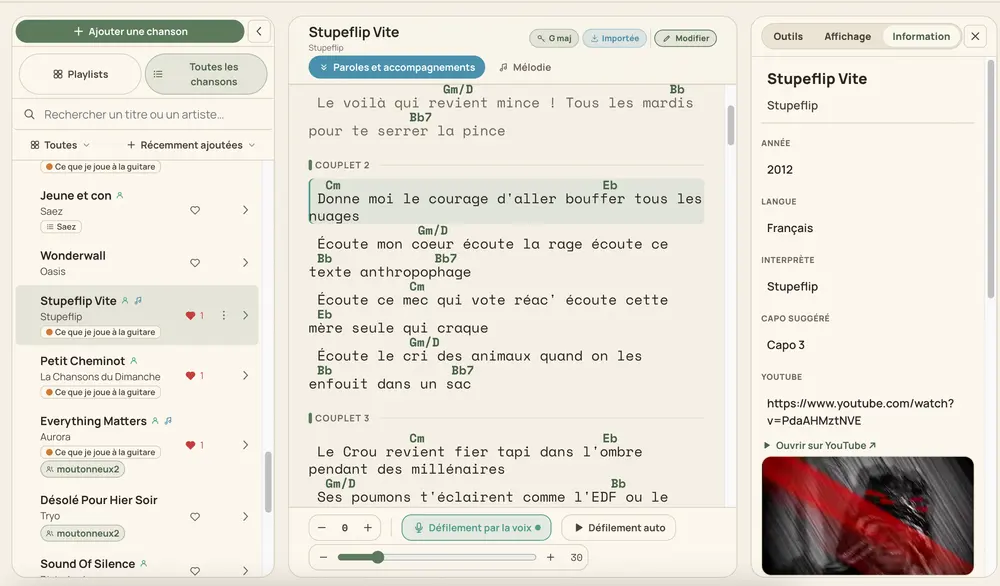
Jam Jam’s songbook (free, with an account) transposes a song by semitones and ranks capo positions from 0 to 12 by how easy the resulting shapes are. Chords are always stored at their real pitch: the capo only changes the shapes on screen, and removing it brings back the original chords.
There is a capo for the piano too: read what is new in the Jam Jam keyboard, including the keyboard capo.
Frequently asked questions about the capo
How do I know which chord I am playing with a capo?
Add as many semitones to the shape as the fret number. D shape at capo 2: D + 2 semitones = E. The capo chart gives the result directly for common open shapes.
What chord is a G shape at capo 2?
A major (A). With the same capo, the C shape gives D, the D shape gives E and the Em shape gives F♯m.
Where do I put the capo to play in B♭?
Three common options: capo 1 with A shapes, capo 3 with G shapes, or capo 6 with E shapes. Capo 3 with G shapes is often the most comfortable.
Does a capo change minor chords?
No, it only changes the pitch. An Am shape at capo 2 is still a minor chord: it sounds Bm.
Paste a song’s chords into the Jam Jam songbook: it transposes them and suggests the easiest capo position.