 Jam Jam
Free · works in your browser · a free account keeps your songbook in sync
Read a tab that actually plays
Paste a tab you found on a forum: Jam Jam reads it, plays it at your speed and can show it on a staff instead.
- No account
- No ads on the web
- Nothing to install
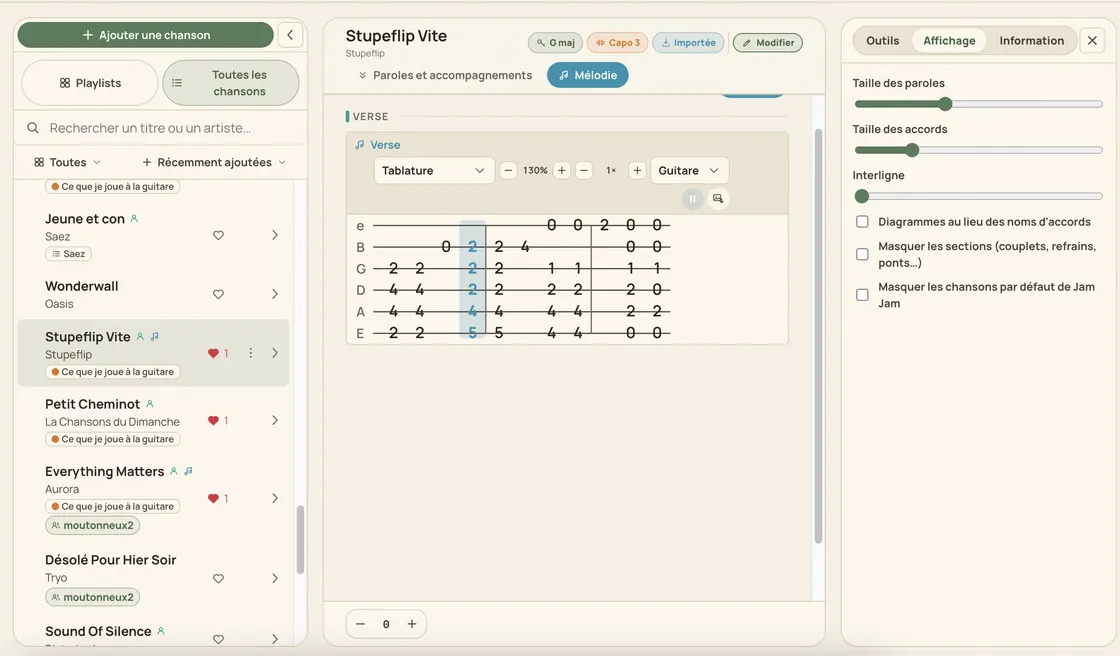
A tab found on a forum is frozen text: no sound, no tempo, no way to move it to another key. Paste it into Jam Jam in the usual ASCII format (e|--0-2--|) and it becomes a real melody: 18 tab instruments (guitar, bass, ukulele, guitalele, mandolin, banjo, violin, viola, cello, oud, bouzouki, balalaika, charango, cavaquinho, shamisen, double bass, lap steel, sitar) each in its real tuning, frets up to 24, playback from ×0.5 to ×2 in steps of 0.25 and a cursor that follows note by note. It lands in your songbook, where transposition from −6 to +6 semitones and the capo put it back in your key.
How to read a tab online
-
Paste your tab
Copy the ASCII block from any forum and paste it: the parser recognises the notation on its own.
-
Pick your instrument
Guitar, bass, ukulele, banjo… the tab is re-read in the real tuning of the instrument you choose.
-
Press play
A cursor follows the notes, from ×0.5 to ×2 in steps of 0.25, with zoom from ×0.6 to ×3 for tired eyes.
-
Keep it in your songbook
The melody joins your song: transposable, playable again, and exportable to PDF with the chords and lyrics.
What a tab site does not do
A tab that sounds, not a picture
The ASCII format used on every forum is parsed note by note: frets, strings and durations become a playable melody, not a frozen screenshot.
Eleven ways to read one melody
Tab, staff, falling notes, note names, harmonica, accordion, handpan, kalimba, harp, mallets, steelpan: switch views without importing anything again. The tab is only a display, never the storage format.
Real tuning for 18 instruments
Guitar, bass, ukulele, guitalele, mandolin, banjo, violin, viola, cello, oud, bouzouki, balalaika, charango, cavaquinho, shamisen, double bass, lap steel and sitar, and the banjo fifth string really starts at fret 5, exactly like on the instrument.
Eight written notations understood
Plain letters, letters with octave, apostrophes, solfège, jianpu, harmonica tab, MIDI numbers, ASCII tab: the parser detects the notation and only asks when two readings are equally likely.
What the reader does
- Frets up to 24, zoom ×0.6 to ×3, fret numbers relative to the capo
- Playback ×0.5 to ×2 in steps of 0.25, with a cursor that follows
- Also imports MIDI, MusicXML, a photo or a PDF of sheet music
- PDF export of the tab: 10 of the 11 views can be printed

A tab site shows you text and stops there. Here the tab is only one view of a melody stored in your songbook: the same song reads on a staff for people who sight-read, transposes from −6 to +6 semitones together with the chords and the fingering diagrams, and leaves as a vector PDF that Jam Jam can re-import without losing a character. That chain (tab, songbook, export) is what a standalone reader never gives you.
Open the tab player →More Jam Jam tools
Tab reader FAQ
Is it free?
Yes, with a free account, because your songbook is synced across your devices. The free tier covers 10 imports a week, 50 songs in the songbook and 10 exports a week (PDF, text and ChordPro included) with every counter resetting on Monday.
Which instruments are supported?
Eighteen: guitar, bass, ukulele, guitalele, mandolin, banjo, violin, viola, cello, oud, bouzouki, balalaika, charango, cavaquinho, shamisen, double bass, lap steel and sitar, each in its real tuning. Long melodies are split into systems, like real sheet music.
What if I only have a photo of the sheet music?
Photograph it or send the PDF: online sheet-music recognition pulls the melody out, allowing up to three minutes of processing on a dense page. MIDI and MusicXML files work too.