 Jam Jam
Free · works in your browser · no sign-up
Chord diagrams for 26 instruments
The same chord, drawn on your instrument: with the colours that tell you what each note is doing.
- No account
- No ads on the web
- Nothing to install
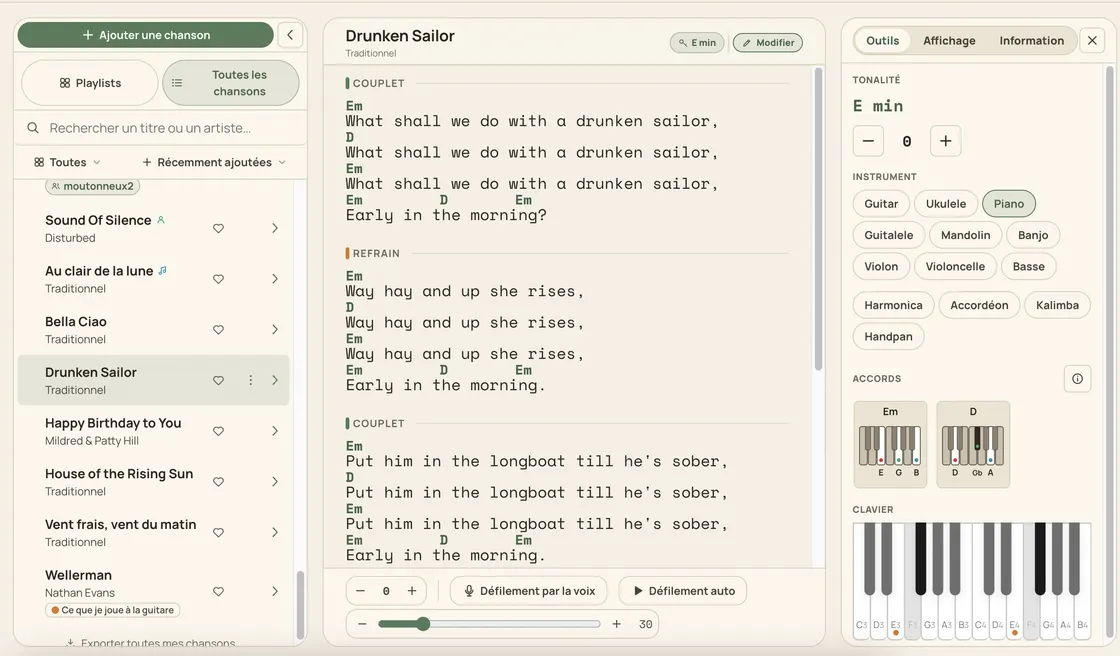
A chord diagram is a map: the strings, the frets, and a dot wherever a finger goes. Jam Jam draws that map on 26 instruments (guitar, piano, ukulele, guitalele, mandolin, banjo, bass, violin, viola, cello, Circuit Tracks) plus fifteen almost nobody else covers: harmonica, accordion, kalimba, handpan, bouzouki, charango, cavaquinho, balalaika, sitar, lap steel, shamisen, contrabass, harp, mallets and steelpan. 379 of the fingerings are written one by one rather than generated on the fly, so what you read is a shape you can actually hold. Five colours name the role of every note, and the diagram follows the transposition and the capo of the song open in your notebook. Free, in your browser.
How to read a chord diagram
-
Pick your instrument
Twenty-six in all, from guitar and piano to handpan, kalimba, harmonica and accordion: each drawn its own way.
-
Read the grid
Strings run one way, frets the other, and a dot marks every finger: 15 frets on guitar, 22 on banjo.
-
Read the colours
Magenta is the root, green the third that decides major or minor, teal the fifth, purple a 7th or a 9th.
-
Change position, or zoom
Guitar, guitalele and banjo offer up to 6 positions; a full-screen magnifier rotates the neck so it fits.
Diagrams other sites do not draw
Twenty-six instruments, harmonica included
Guitar, piano, ukulele, guitalele, mandolin, banjo, bass, violin, viola, cello and Circuit Tracks: plus harmonica, accordion, kalimba, handpan, bouzouki, charango, cavaquinho, balalaika, sitar, lap steel, shamisen, contrabass, harp, mallets and steelpan, which almost nobody draws.
379 fingerings written one by one
181 guitar, 88 ukulele, 72 piano, 44 mandolin, 31 guitalele, 30 banjo: picked because they are playable, not generated at random. Elsewhere the diagram is built from the notes the instrument can really reach.
Colours that mean something
Root in magenta, third in green (it is the one that decides major or minor), fifth in teal because it steadies the chord, 7th or 9th in purple, and the bass of a slash chord like C/G in red, to sound first.
A legend for every instrument
The ⓘ button explains the symbols of the instrument you are on: harmonica ▲ blow, ▼ draw and holes 1 to 10, accordion ▲ push, ▼ pull, kalimba tines, handpan Ding and strike zones.
Why read your chords here
- 26 instruments: handpan, kalimba, harmonica and accordion included
- 379 fingerings written one by one, chosen to be playable
- Up to 6 positions per chord on guitar, guitalele and banjo
- Free, in your browser, no sign-up: also in the Android app

A diagram is not a poster: it belongs in the middle of a song. What chord detection hears is drawn straight away on the instrument you play, and every diagram follows your notebook. Transpose from −6 to +6 semitones and the shapes move with you; set a capo among 13 positions and the fret numbers are read against it. That chain. Ear, notebook, fingers. Runs in the browser, and offline in the Android app.
Open the chord diagrams →More Jam Jam tools
Chord diagram FAQ
How do I read a chord diagram?
Strings run one way, frets the other, and a dot shows where each finger goes. In Jam Jam the colours add the role of every note, and the ⓘ button gives the full legend for the instrument you are on.
Is it free, and which instruments are covered?
It is free and runs in your browser, with nothing to install. Twenty-six instruments are drawn, from guitar and piano to handpan, kalimba, harmonica and accordion; the Android app draws them offline.
Are there several positions for the same chord?
On guitar, guitalele and banjo, yes: up to 6, the open idiomatic shapes first, then positions further up the neck. The other instruments show one position, and so do slash chords like C/G.